
Innovative Branding Ideas | AD Vantage Integrated Marketing

Posted on October 23, 2026
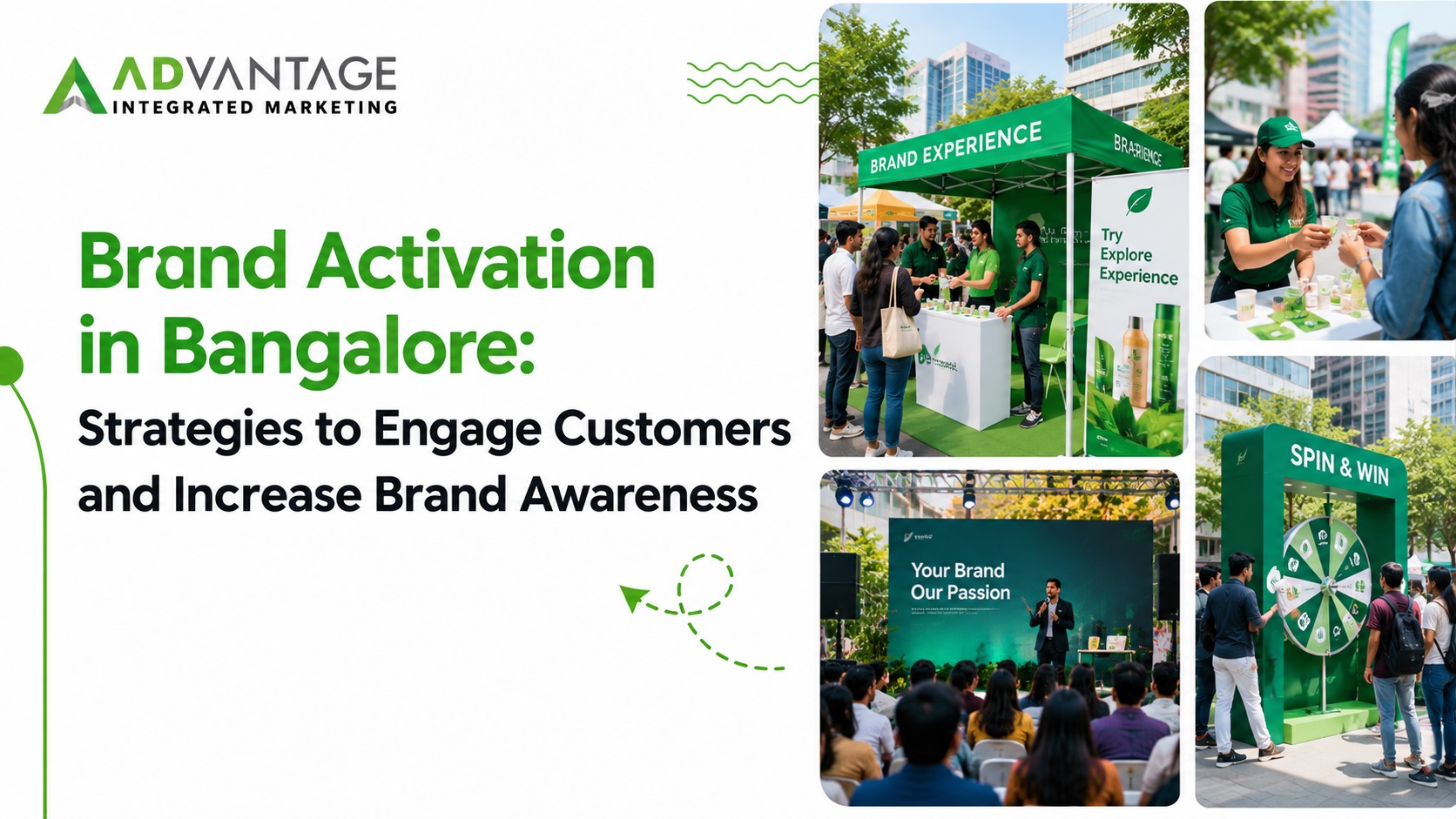
In a competitive market like Bangalore, getting customers to notice your brand is only the first step. The real opportunity lies in creating experiences that encourage people to interact with your business, understand your products, and remember your brand afterwards. This is where a professional brand activation agency Bangalore businesses work with can make a difference.
Brand activation turns marketing communication into direct customer experiences through product demonstrations, retail promotions, live events, experiential campaigns, and interactive activities that bring a brand closer to its audience. For businesses looking to strengthen brand awareness, introduce new products, or build stronger relationships, a well planned activation creates meaningful engagement. The key is to connect the experience to a clear business objective rather than organise an activity simply to attract attention.
Brand activation is a marketing approach that encourages customers to experience a brand through direct interaction. Instead of relying entirely on advertising messages, it gives people a chance to participate, explore, sample, or engage with a product or service.
A beverage company might offer sampling at a busy retail location. A furniture brand could create an interactive display where visitors experience the materials and finishes. A technology company might run a demonstration that lets customers test a new product. These activities make the brand experience more tangible.
Effective brand activation combines three elements: a clearly defined audience, an engaging experience, and an objective that can be evaluated afterwards. Depending on the business, that objective may be to generate trials, increase enquiries, encourage store visits, collect qualified leads, or improve awareness of a new offering.
Bangalore has a diverse business environment spanning technology companies, retail brands, restaurants, educational institutions, consumer businesses, and startups. Reaching these audiences requires more than repeating the same message across every channel. This is one reason so many companies now partner with a brand activation agency Bangalore brands trust to connect with customers where participation feels relevant.
Customers can ask questions, try products, speak with brand representatives, and understand an offering more clearly. This is particularly useful when a product requires demonstration or customers need more information before buying.
A well designed demonstration, useful activity, or relevant event creates a stronger impression than a message customers simply scroll past.
When introducing a new product, businesses need to explain what makes it different. Sampling, demonstrations, launch events, and interactive displays help communicate those benefits directly.
With the right setup, activations encourage interested customers to register for a demonstration, request a quotation, visit a store, or speak with a sales representative. A brand activation agency Bangalore businesses choose should connect these interactions to the intended objective.
The best format depends on your audience, product, budget, and goal. These are the formats a capable brand activation agency Bangalore companies rely on will usually recommend.
Experiential marketing lets customers experience a brand through an activity, installation, demonstration, or immersive environment. A lifestyle brand could create a themed experience at a shopping destination, while a furniture company could build a display that lets visitors compare designs and finishes. The experience should connect clearly to the brand. An activity that attracts a crowd but fails to communicate value generates attention without results.
Retail activations engage customers at the point where purchase decisions are made, through demonstrations, sampling counters, promotional displays, interactive kiosks, and launch activities. Location and execution matter most here. The activation should be easy to notice without obstructing store operations, and staff should be trained to explain the product and guide customers to the next step.
Sampling works well for products customers can experience directly, such as food, beverages, and personal care goods. Demonstrations suit products that need explaining. To evaluate these campaigns, track samples distributed, demonstrations completed, enquiries generated, and purchases where available. The goal is not simply to hand out products but to understand whether the activity influences interest.
Events help brands build relationships with specific audiences through exhibitions, product launches, sponsorships, or interactive sessions. The format should match the audience. A business targeting corporate decision makers may benefit more from a focused industry event than a large public activation with limited relevance.
Outdoor environments reach people in busy commercial areas, retail districts, and transit locations. Brands may combine outdoor advertising and transit branding with promotional activities or interactive experiences. Permissions, site suitability, pedestrian movement, and safety should be confirmed before execution, since a visually impressive concept must also work practically.
A successful activation begins well before the event. A structured process ensures the idea, audience, location, and execution all support the same objective.
Step 1: Define the objective. Decide what the campaign must achieve, whether introducing a product, improving awareness, generating enquiries, or encouraging store visits. A clear priority makes it easier to choose the format and evaluate the outcome.
Step 2: Understand your audience. Consider who you want to reach, what they care about, and what might motivate them to participate. The closer the experience matches their interests, the more relevant it feels.
Step 3: Select the right location. Consider audience relevance, footfall, accessibility, space, permissions, and suitability. A smaller location with a highly relevant audience often delivers better qualified interactions than a busier one with limited relevance.
Step 4: Develop a clear creative concept. Design the activity around one central idea and make the next step clear, whether trying a product, scanning a code, registering interest, or speaking with a representative.
Step 5: Plan execution and staffing. Cover production, setup, materials, logistics, safety, and venue coordination. Representatives should understand the product, the objective, and how to handle questions and record responses.
Step 6: Measure the results. Set the measurement approach before you begin. Useful indicators include participants, samples or demonstrations completed, qualified leads generated, store visits or purchases linked to the campaign, customer feedback, and cost per qualified lead. Footfall alone does not prove increased sales, so connect the data to the original objective.
A well planned activation builds awareness when the experience is relevant, recognisable, and consistent with the wider campaign.
Create a recognisable experience. Use consistent brand colours, messaging, and product presentation so participants identify the business easily.
Choose participation over passive exposure. Give people a useful reason to interact through a demonstration, trial, competition, or practical experience.
Connect to other channels. Coordinate with social media, retail communication, outdoor advertising, and digital promotion so customers meet a consistent message before, during, and after the activity.
Make participation easy. Avoid complicated registration or unclear instructions.
Follow up with interested customers. Where consent is obtained, use relevant follow up to answer questions and support the next stage of the purchase journey.
Choosing a location based only on footfall: Audience relevance matters as much as the number of people passing through.
Focusing on entertainment without a brand connection: An enjoyable activity should still communicate the message.
Ignoring staff preparation: Poor product knowledge weakens the experience.
Overlooking permissions and logistics: Approvals, safety, and setup should be confirmed in advance.
Failing to collect useful data: Without a measurement plan, it is hard to learn what worked.
Expecting immediate sales from every activation: Some campaigns build awareness or trials, so evaluate performance against the objective.
Planning a successful activation requires coordination between the creative concept and its execution. AD Vantage Marketing offers integrated marketing capabilities across brand activations, experiential marketing, outdoor advertising, transit branding, and retail branding. An activation can be supported by outdoor advertising that builds awareness beforehand and retail branding that reinforces the message at the point of purchase.
When evaluating a brand activation agency Bangalore businesses can work with, consider its ability to understand your objectives, plan the right format, coordinate execution, and measure results. Discuss your audience, requirements, locations, budget, and timelines before finalising the plan, since these details create a clearer brief.
If you are planning a product launch, engagement initiative, or experiential campaign, AD Vantage Marketing is the brand activation agency Bangalore businesses can rely on for integrated solutions that work.
Visit: https://advanintegrated.in/